Required Minimum Distributions (RMDs) for Dividend Investors
Dividends paid inside an IRA do not count toward your required minimum distribution (RMD) on their own. Only money that leaves the account counts. But dividend cash that builds up in the account can be withdrawn to meet the RMD, so you never have to sell a share to make it.
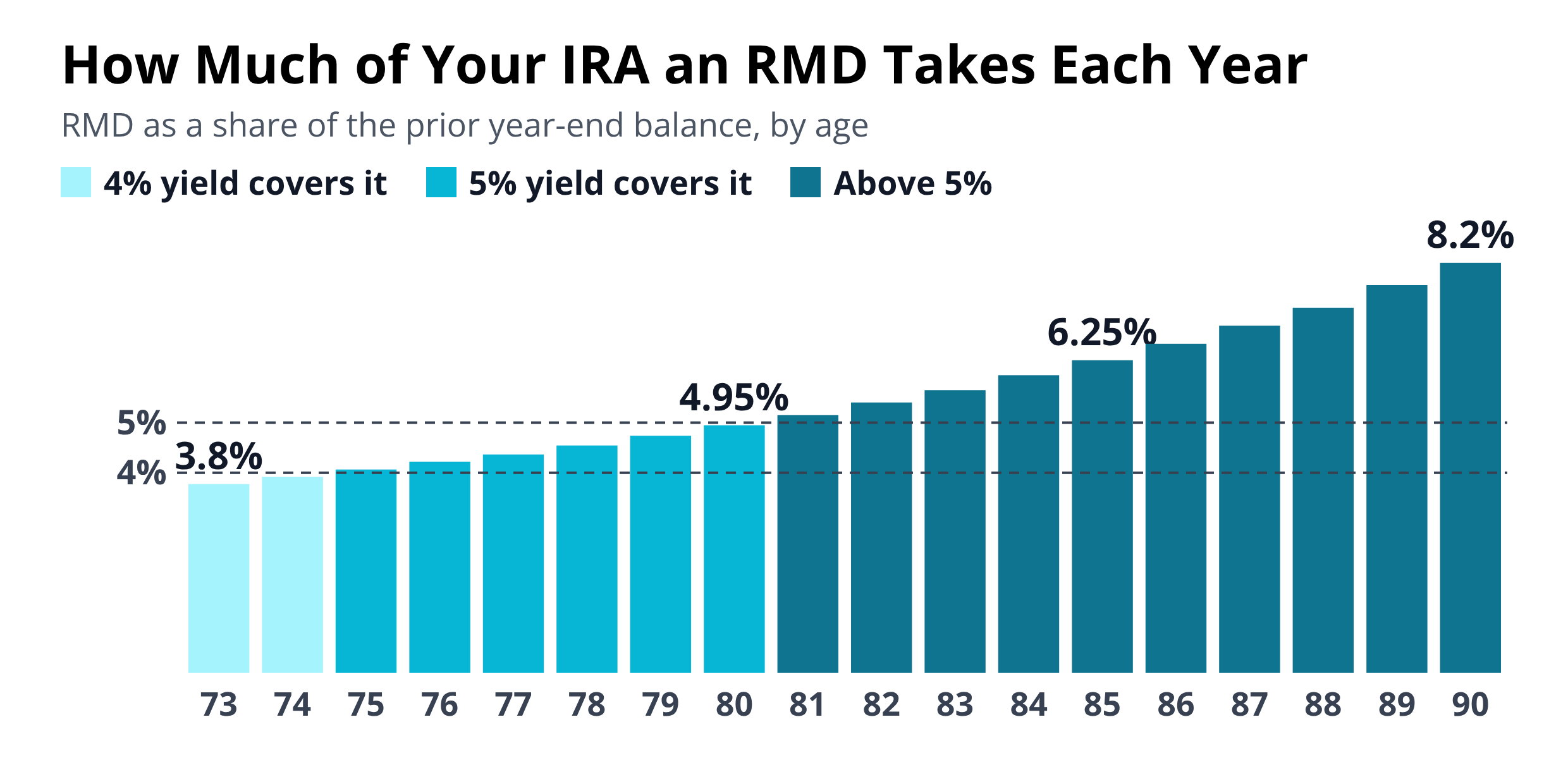
How far dividends can carry you depends on your yield and your age. The RMD at age 73 is 3.8% of your account, so a 4% yield covers it at 73 and 74. A 5% yield covers it through age 80. After that, the required withdrawal outgrows almost any safe yield.
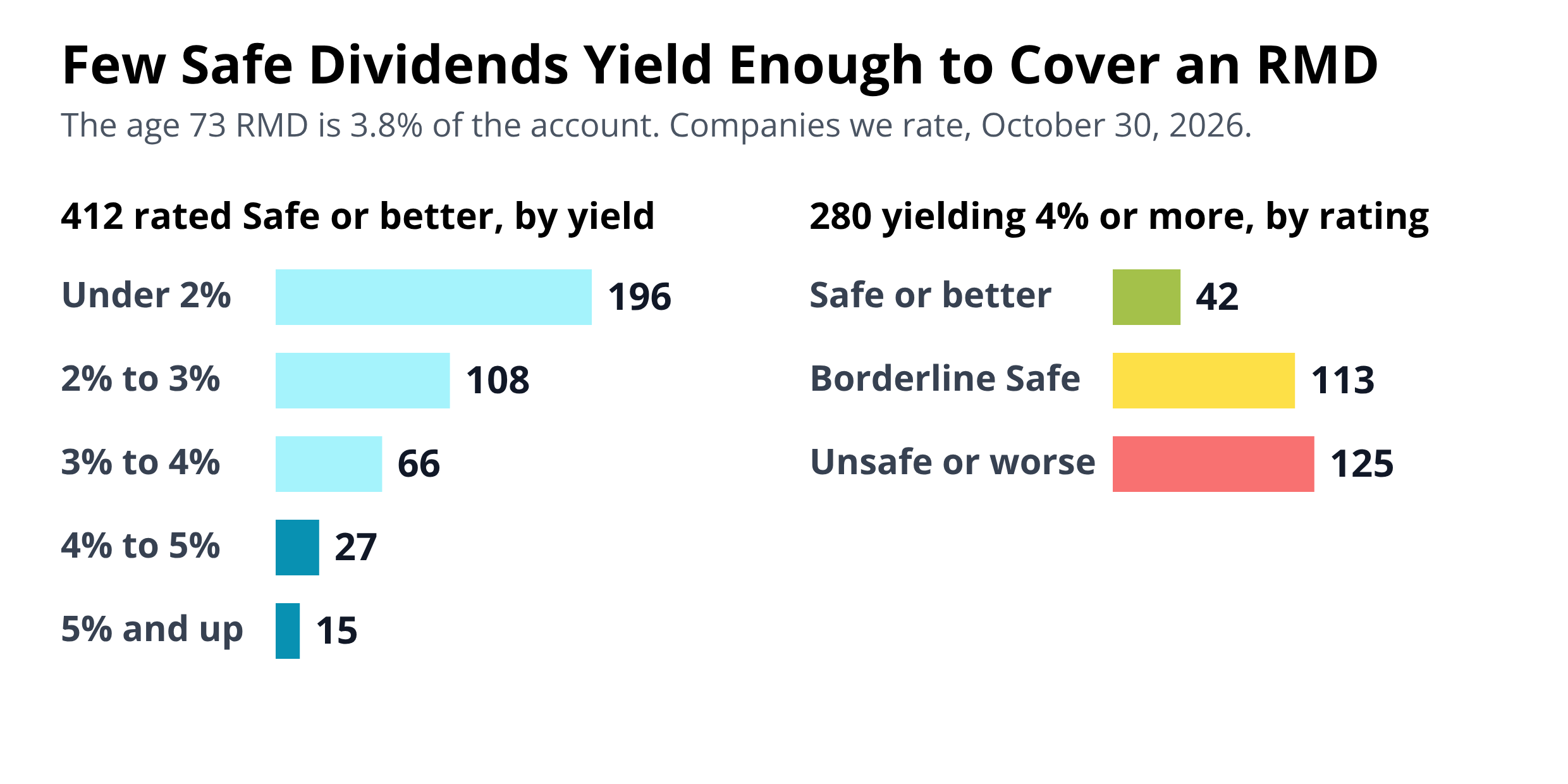
That is the catch. Of the 865 companies we rate with our Dividend Safety Scores, 412 earn a Safe rating or better, and only 42 of those yield 4% or more, as of October 30, 2026. Reaching for a higher yield to fund an RMD usually means taking on more risk to the dividend.
Below we explain how RMDs work, how much they require at each age, whether dividends count, how to fund an RMD with dividends, and what the IRS says about taxes and charitable gifts.
What Is a Required Minimum Distribution?
An RMD is the minimum amount you must withdraw from a tax-deferred retirement account each year once you reach a certain age. It applies to traditional IRAs, SEP and SIMPLE IRAs, and workplace plans such as 401(k)s.
The reason is simple. Money in these accounts has never been taxed. Contributions went in before tax and the gains compounded untaxed for years or decades. RMDs make sure that money is eventually withdrawn and taxed.
Under current law, you generally must start taking RMDs at age 73 if you were born from 1951 through 1958, according to the IRS. Treasury regulations set the starting age at 75 for anyone born in 1960 or later, and the final rule for people born in 1959 has not been issued yet. Your first RMD can wait until April 1 of the year after you reach your starting age. Every later RMD is due by December 31.
Delaying the first one has a cost. If you turn 73 in 2026 and wait until April 1, 2027, you will also owe your 2027 RMD by December 31, 2027. That puts two withdrawals into one tax year.
Roth IRAs and designated Roth accounts have no RMDs while the owner is alive, the IRS says. Beneficiaries who inherit them do face RMD rules.
Missing an RMD is expensive. The amount you should have withdrawn may be subject to a 25% excise tax, cut to 10% if you correct it within two years.
How Your RMD Is Calculated
Each year's RMD equals your account balance on December 31 of the prior year divided by a distribution period from an IRS life expectancy table. Most IRA owners use the Uniform Lifetime Table. The exception is an owner whose spouse is the sole beneficiary and more than 10 years younger, who uses a separate joint life table that produces smaller RMDs.
The distribution period shrinks each year, so the share of your account you must withdraw rises with age. At 73 the divisor is 26.5, which works out to 3.8% of your balance. At 80 it is 20.2, or 4.95%. At 90 it is 12.2, or 8.2%.
In dollars, a $500,000 IRA requires an $18,868 withdrawal at age 73. At age 80, the same $500,000 balance would require $24,752.
Most brokers calculate the RMD for you and show how much you have already withdrawn during the year.
Do Dividends Count Toward Your RMD?
No, not by themselves. Dividends paid by the stocks and funds in your IRA stay in the account, so they add to your balance rather than reduce it. In fact, every dividend you leave in the account becomes part of next year's RMD calculation.
What counts is what you withdraw. Once dividend cash is sitting in the account, you can withdraw it, and that withdrawal counts toward your RMD like any other. That is how dividend investors fund RMDs without selling shares.
Taking more than the minimum does not help you later. The IRS gives no credit toward future years' RMDs for an extra withdrawal this year, according to Publication 590-B.
Can Dividends Cover Your Whole RMD?
For a while, yes. Your dividend yield is roughly the share of your account that dividends pay you each year, and the RMD is a share of the account too, so the two can be compared directly.
A 4% yield matches the RMD at ages 73 and 74. A 5% yield covers it through age 80. By 85 the RMD is 6.25% of the account, and by 90 it is 8.2%. At that point most investors will be withdrawing some principal no matter how they are invested.
The comparison is not exact. The RMD is based on last year's ending balance, while your dividends depend on what you own this year and whether those companies raise or cut their payouts. A growing dividend helps you keep pace for a few more years.
The harder problem is finding yields that high without putting the income at risk. As of October 30, 2026, only 42 of the 412 companies we rate Safe or better yield at least 4%, and none of our Very Safe names does. Among all 280 rated companies yielding 4% or more, 125 earn an Unsafe or Very Unsafe Dividend Safety Score.
The higher-yielding names that do score Safe cluster in a few sectors, led by real estate, utilities and financials. Our list of high dividend stocks walks through the strongest of them.
Longtime Simply Safe Dividends contributor Dave Van Knapp learned this firsthand. He set out to fund every RMD from dividends alone and even held a year's worth of dividends in cash before his first one. He dropped the goal within a couple of years.
He did not want the goal to push him into chasing yield, gradually tilting his IRA toward ever-riskier payers just to hit a withdrawal target. He also preferred to keep reinvesting dividends rather than parking them in cash all year. We agree with his reasoning. An RMD is a withdrawal schedule, not an income target, and a dividend cut in a stock you bought only for its yield costs more than selling a few shares.
How to Fund an RMD With Dividends
You do not need an all-or-nothing approach. Most dividend investors who fund RMDs from income use a few simple habits.
Let some dividends collect as cash. Instead of reinvesting every dividend inside the IRA, let enough build up during the year to cover the coming RMD. Many brokers let you turn off reinvestment for one account or one holding at a time.
Withdraw on your own schedule. The RMD can be taken in installments, such as monthly or quarterly, as long as the total for the year reaches the minimum, according to Publication 590-B. Some retirees set up a monthly transfer that roughly matches their dividend income.
Use one IRA as the income account. If you own more than one traditional IRA, you must calculate the RMD for each, but you can take the total from any one or more of them. Holding your income stocks in one IRA and taking the whole amount from it keeps things simple. That flexibility does not extend to 401(k)s and similar plans, where each plan's RMD must come from that plan.
Fill any gap by trimming, not by reaching for yield. When dividends fall short, sell a little stock rather than swapping into riskier payers. The next section explains how to decide what to sell.
Ask about in-kind withdrawals. Many brokers also let you take an RMD by moving shares to a taxable account instead of selling them. Ask your broker and a tax professional how the shares are valued and taxed before you rely on it.
Where to Sell When Dividends Fall Short
Over long periods, the stock prices of stable dividend payers tend to follow their dividends. A company that raises its payout 5% a year usually sees its shares climb at a similar pace over time, so its yield drifts around a fairly steady level. That idea, which we explain in our guide to dividend yield theory, gives you a simple way to choose which shares to sell for an RMD.
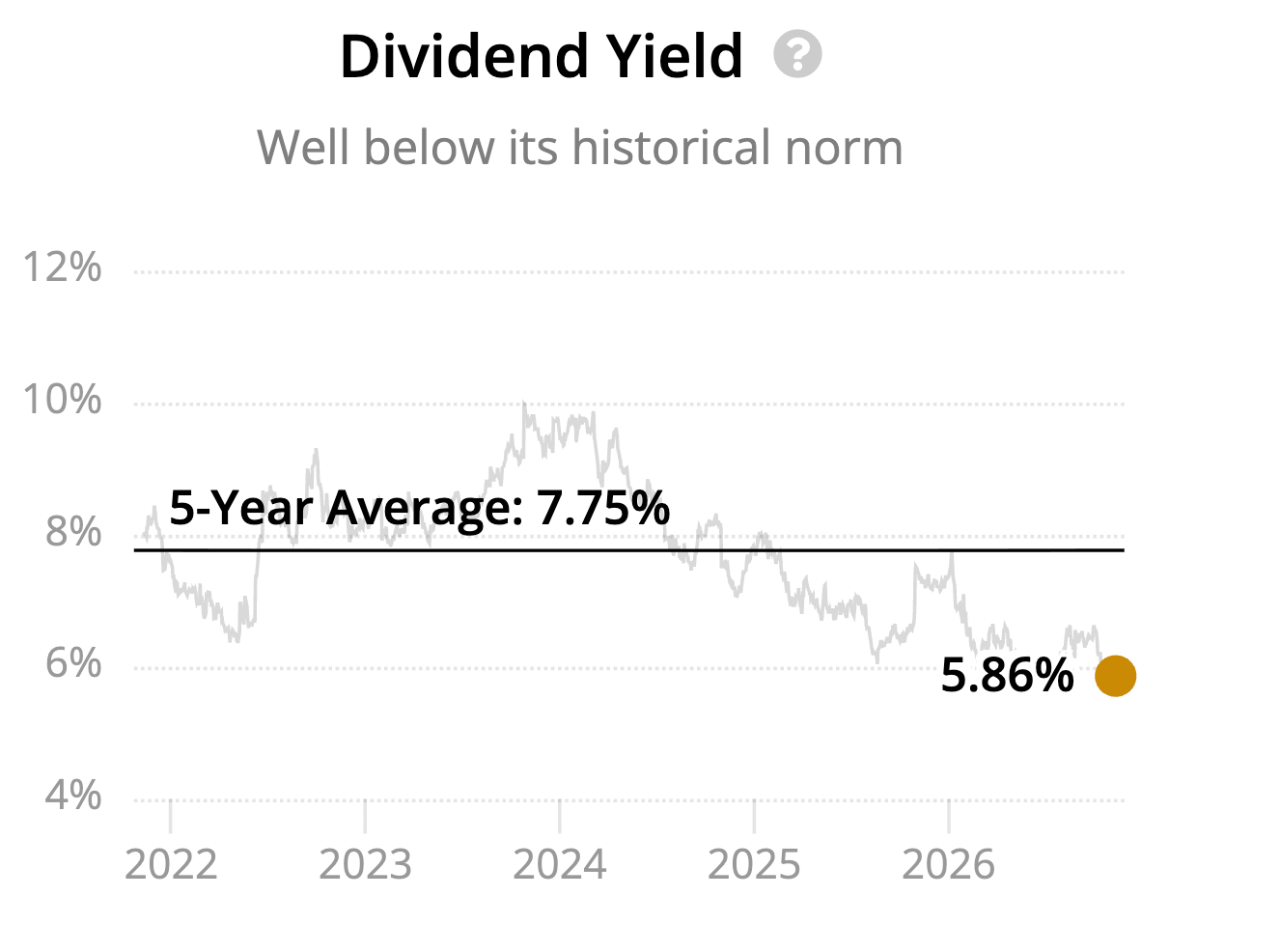
Compare each holding's current yield with its own five-year average. A yield well below its average usually means the share price has run ahead of the dividend. That is the natural place to trim, because you are selling what the market currently values most richly. A safe dividend trading at a yield above its average is the opposite case, and usually the last thing you want to sell.
Altria (MO) shows how this works. The stock has nearly doubled since early 2024, far outpacing its dividend growth, so its yield has fallen to 5.9% from a five-year average of 7.75%. When we reviewed the company in July, we said the rally made it a reasonable time to review position sizes rather than add. For an Altria holder who needs to sell some shares for an RMD, that is a sensible place to start.
Two cautions apply. This framework only works for stable businesses with safe dividends. A yield that jumps because the market expects a cut is a warning, not a bargain, which is why we check every holding's Dividend Safety Score first. And it is a guide for where to take sales, not a reason to sell more than you need.
How RMDs Are Taxed
The IRS taxes your RMD at your income tax rate on the amount withdrawn, except for any part that is a return of money that was already taxed. The withdrawal is added to the rest of your income for the year, so a large RMD can push some income into a higher bracket.
That holds whatever the money earned inside the account. Dividends that would qualify for lower tax rates in a taxable account do not keep that treatment when they come out of a traditional IRA as part of a withdrawal. Our guide to taxes on dividends covers how dividends are taxed in regular brokerage accounts.
Because the IRS counts all of your other income when deciding whether Social Security benefits are taxable, an RMD can also make more of your benefit taxable. Our guide on how dividends affect Social Security explains how that works.
Ways to Lower the Tax on Your RMD
Qualified charitable distributions (QCDs). If you already give to charity, a QCD lets you send money straight from your IRA to a qualified charity. You must be at least 70½ when the gift is made. The amount is excluded from your income and counts toward your RMD, according to Publication 590-B. The maximum exclusion was $108,000 per person for 2025. You cannot also take a charitable deduction for the same gift, and the money must go directly from the IRA to the charity.
Roth conversions before RMDs begin. Moving money from a traditional IRA to a Roth IRA means paying tax on it now, but it shrinks the balance future RMDs are based on, and Roth IRAs have no RMDs during your lifetime. Whether that pays off depends on your tax bracket today versus later, so it is worth working through with a tax professional. Our comparison of traditional and Roth IRAs for dividend investors goes deeper.
Withdraw more in low-income years. Some retirees take more than the minimum in years when their income is unusually low. That shrinks the balance and future RMDs, though the extra withdrawal earns no credit against later RMDs.
What to Do With an RMD You Don't Need
The IRS requires the withdrawal, not the spending. You cannot roll an RMD into another tax-deferred account, the IRS says, but once it is out you are free to keep it in cash, pay down debt, give it away or invest it in a regular brokerage account.
Many dividend investors simply move the after-tax amount into a taxable account and buy more dividend stocks, where future dividends may qualify for lower tax rates. If you are still deciding how much income you need, our guide to living off dividends can help you size the portfolio.
Frequently Asked Questions
Do dividends count toward an RMD?
Not on their own. Dividends paid inside an IRA stay in the account and only count once you withdraw them. Withdrawing dividend cash that has built up in the account is a common way to meet an RMD without selling shares.
Not on their own. Dividends paid inside an IRA stay in the account and only count once you withdraw them. Withdrawing dividend cash that has built up in the account is a common way to meet an RMD without selling shares.
At what age do RMDs start?
Generally age 73 if you were born from 1951 through 1958 and 75 if you were born in 1960 or later, under current law. Final rules for people born in 1959 are still pending. See the IRS for details. The first RMD can be delayed until April 1 of the following year, but then two RMDs fall in the same tax year.
Generally age 73 if you were born from 1951 through 1958 and 75 if you were born in 1960 or later, under current law. Final rules for people born in 1959 are still pending. See the IRS for details. The first RMD can be delayed until April 1 of the following year, but then two RMDs fall in the same tax year.
How much dividend yield do I need to cover my RMD?
About 3.8% at age 73, 4.1% at 75, 4.95% at 80, 6.25% at 85 and 8.2% at 90, based on the IRS Uniform Lifetime Table. A 4% yield covers ages 73 and 74, and a 5% yield covers through 80.
About 3.8% at age 73, 4.1% at 75, 4.95% at 80, 6.25% at 85 and 8.2% at 90, based on the IRS Uniform Lifetime Table. A 4% yield covers ages 73 and 74, and a 5% yield covers through 80.
Can I reinvest my required minimum distribution?
You cannot roll it into another IRA or other tax-deferred account. After it is withdrawn and taxed, you can invest it in a regular brokerage account.
You cannot roll it into another IRA or other tax-deferred account. After it is withdrawn and taxed, you can invest it in a regular brokerage account.
Can I take all of my RMDs from one IRA?
Yes, for traditional IRAs. You calculate the RMD for each IRA separately but can take the total from any one or more of them. Each 401(k) or similar workplace plan must cover its own RMD.
Yes, for traditional IRAs. You calculate the RMD for each IRA separately but can take the total from any one or more of them. Each 401(k) or similar workplace plan must cover its own RMD.
What happens if I miss an RMD?
The amount you failed to withdraw may be subject to a 25% excise tax, reduced to 10% if you correct the shortfall within two years.
The amount you failed to withdraw may be subject to a 25% excise tax, reduced to 10% if you correct the shortfall within two years.
Do Roth IRAs have RMDs?
Not while the original owner is alive. Beneficiaries who inherit a Roth IRA are subject to RMD rules.
Not while the original owner is alive. Beneficiaries who inherit a Roth IRA are subject to RMD rules.